


Our group of tour guides were excellent in adjusting to the needs of our traveling group. Our original itinerary had us spending this morning touring historic sites within Cusco, eating lunch and the going to the airport by 1:30PM for our flight back to Lima and re-boarding the ship. There wasn’t any free time for shopping or walking around. Some asked for a chance to see some Alpacas. A further complication, is that this is also a Cusco religious holiday with a procession at 2pm that resulted in a lot of roads closed in the morning.
What they worked out was great. They organized an optional trip at 8AM to go outside Cusco town limits to a Peruvian Textiles museum that sells Alpaca products and has a small herd of Alpacas, Llamas and Vicuñas. Then the group would continue on the regular tour within Cusco. Those not wanting to get up that early can take the originally scheduled tour of the Temple of the Sun and the Cathedral starting at 9AM.
We opted to go with the 8AM group. I still had my light breakfast with two cups of coca tea. then we hopped on a bus and headed up to a mountain top (12,500 ft) to the Sulca Textiles Museum, a living museum where they are recreating fabrics and pieces from ancient Peru using ancestral techniques from the different Pre-Columbian Inca, Viceregal and Contemporary cultures. (Web site: https://www.museosulcatextiles.com/). Funding is by the Sulca family and sales of products made here. There were amazing banners and tapestries on display (and for sale), and another building of clothing had women weaving and dying materials, as well as had for some for sale that was of amazing quality. If you remember, I bought an Alpaca sweater yesterday for $20. Mine today cost about $120. Needless to say, Laura and I did buy a few things here. One that I can show is a small tapestry.

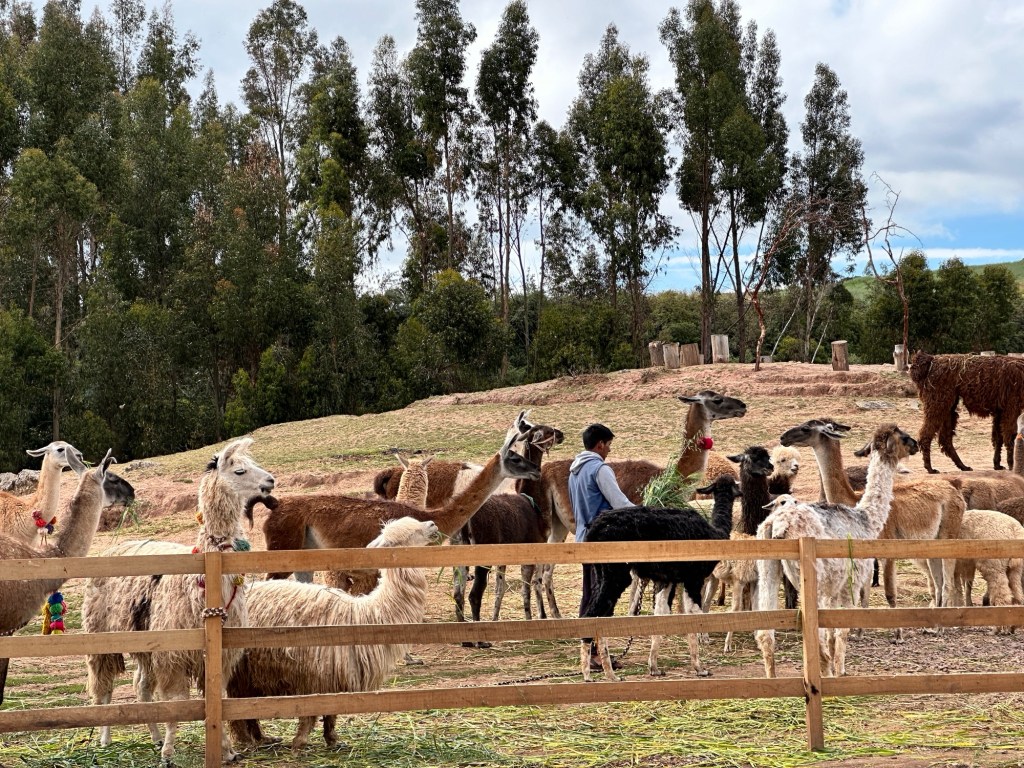
There was in fact a small herd of Llamas, Alpacas and Vicuñas in the back of the complex.

We then returned back to downtown Cusco to the Temple of the Sun. The background is that the Pre-Colombian Incas had made Cusco their empire capital, and the Sun was their Father God, while the Earth was their Mother God. So a temple of the sun was their main and largest temple. It was built with the extremely precise stone cuttings without any mortar, and apparently the interior was completely wrapped in gold. When the Spanish arrived, they captured the Inca king and held him for ransom, demanding all the gold from the temple. The Incas obeyed and stripped all the gold off the temple, but the Spanish still didn’t release the king, demanding more gold. In the end he was killed and Cusco was stripped of all its gold and silver. As was typical of the Spaniards, in Cusco, all temples were converted to churches for the Spanish ministries. So now on top of the foundation and first floor of Inca stone walls were Spanish style arched walls with pillars. Twice in the last 300 years earthquakes have struck Cusco, knocking down the Spanish built walls, but the original Inca walls remain undamaged.

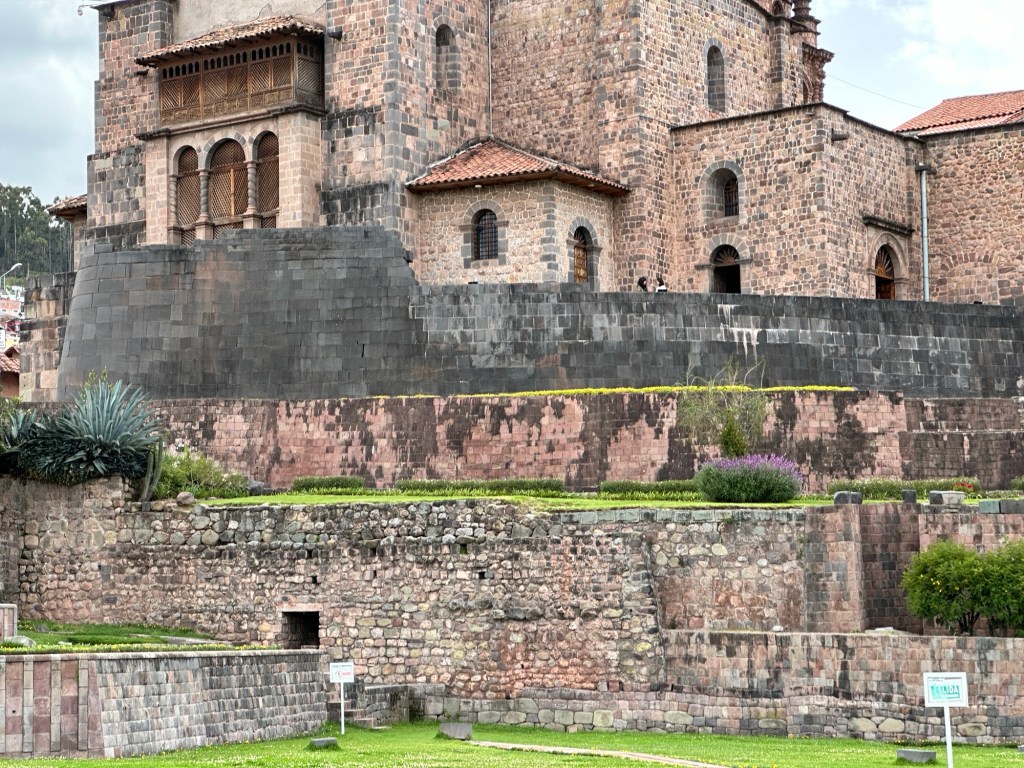

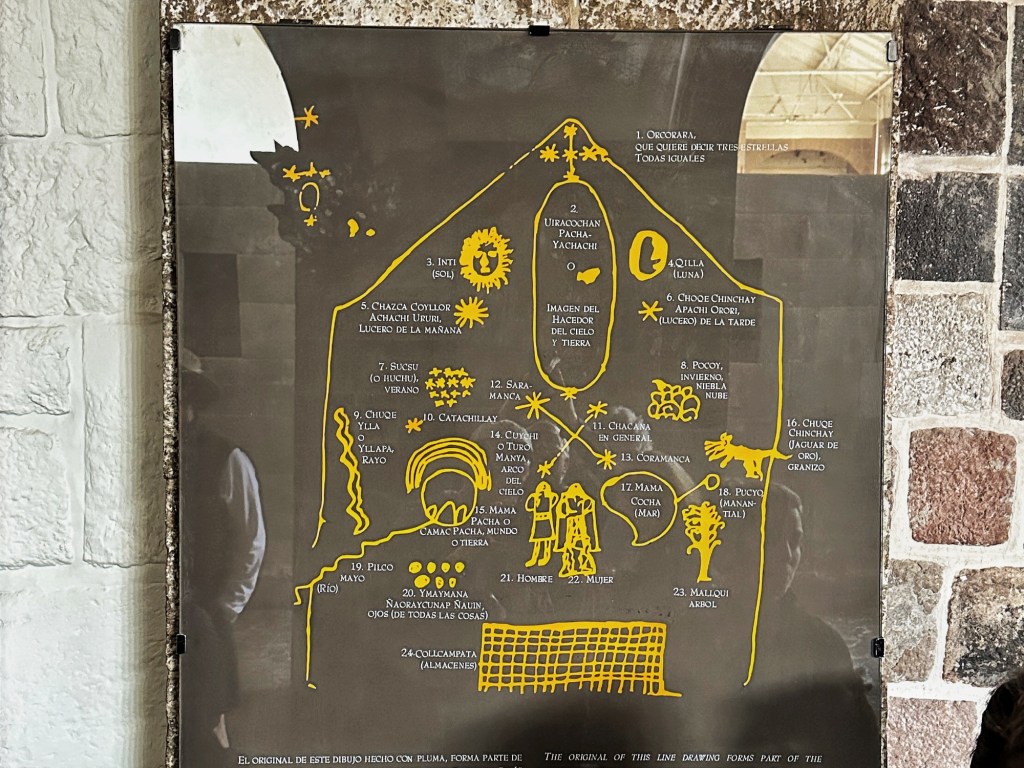
Our guide was trying to explain why the Inca walls survive earthquakes. Stone walls with mortar will have the the lower density mortar vibrate at a different frequency than the solid stones. This density disparity will literally dissolve the mortar during an earthquake, making the stones wobbly and no longer stable. But the Inca stone, first being made of quartz that has a very distinct density that is less destructive when vibrating, and second, the wall vibrates all at the same frequency without any mortar. So they remain stable in an earthquake. In addition, the walls are built at a slight angle into the center of the building which helps further.
The ability to cut such precise stones no longer exists. The guide said the technology used is not known and does not exist even in today’s modern world. He even questioned whether it was the Incas who had the knowledge and skills, or perhaps it was someone else who the Incas used to cut the stones. And by someone else, he wasn’t limiting it to other humans (?). Think of the Nazca Lines in the Peruvian desert.
Leaving the Temple of the Sun, we learned that the bus couldn’t get close to the next stop, the cathedral and we’d have to walk part of the way to the cathedral and again to the restaurant. Some of us opted to skip the cathedral and walk straight to the restaurant, giving us more time to walk at a more leisurely rate, given our shortness of breath. And of course we get hot by street peddlers. Here are some that caught Laura and I.


Lunch was at a museum next door to our hotel. It was very nice, but we still didn’t have much of an appetite, nor did we want any alcohol yet.
Getting to the airport was uneventful, as was our flight back to Lima. we made it back to our ship cabin by 5:30PM and soaked in the sea-level air! Needless to say we slept great that night.
Overall this 3-day overland trip was an opportunity of a lifetime. It was a mind blowing experience, the city of Cusco is uniquely vibrant in its own way, and the Andean mountains are breathtaking. I’m glad I did it and experienced what we did, but I’ll admit I’m probably too old to try it again. For those considering Machu Picchu, there is a new airport being built closer to Machu Picchu than Cusco, that could make the journey less cumbersome. And follow others’ advice and allow a day or two to acclimate to the altitude being doing anything strenuous. Not a in and out like we did.
 Menu
Menu 
Leave a comment